|
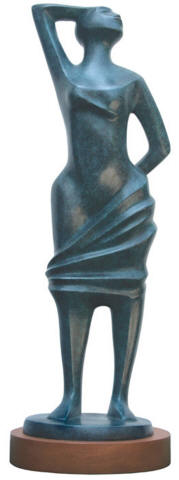
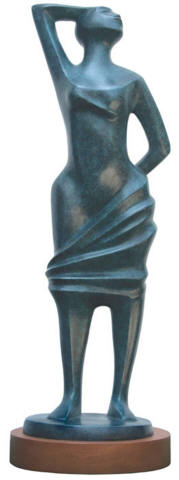
Elizabeth
Catlett
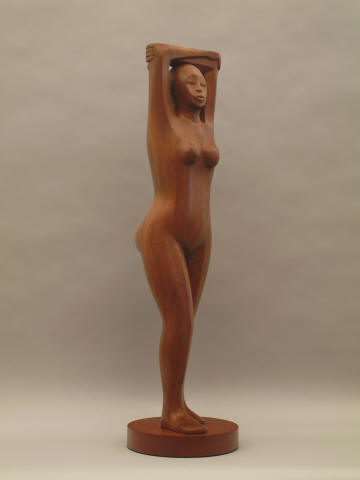
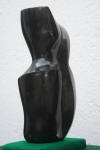
Stepping Out,
2000
Bronze, 30 x 9.25 x 8.25 in.
Ed. 3 of 9 NWA
|
1915 |
Born Washington, DC
Lives in Cuernavaca, Mexico, and New York City |
|
2012 |
Died in Cuernavaca,
Mexico, April 2 |
Education |
|
1955,
1947-48 |
Studied wood carving with Jose L. Ruiz and ceramic sculpture with
Francisco
Zuniga, Escuela de Pintura y Escultura, Esmeralda,
Mexico |
|
1943 |
Studied with sculptor Ossip Zadkine, New York |
|
1942-43 |
Studied lithography at Art Students League, New York |
|
1941 |
Studied ceramics, Art Institute of Chicago, Illinois |
|
1940 |
MFA, University of
Iowa, Iowa City, IA |
|
1935 |
BS, cum laude, Howard University School of Art, Washington, DC |
Selected Solo Exhibitions |
|
2026 |
Elizabeth Catlett:
Sculpture, June Kelly Gallery, New York |
|
2025-26 |
A Black
Revolutionary Artist and All That It Implies, retrospective, opened
at the
Brooklyn Museum, NY. , traveled to the
National Gallery of Art, Washington,
D.C., and The Art Institute of Chicago,
IL. |
|
2019 |
Elizabeth Catlett:
An Ardent Feminist, June Kelly Gallery, New York |
|
2014 |
Remembering
Elizabeth Catlett, June Kelly Gallery, New York |
|
2009 |
Elizabeth Catlett:
Recent Sculpture, June Kelly Gallery, New York
Six Decades: Drawing and Prints by Elizabeth Catlett, Stella
Jones Gallery, New Orleans, LA |
|
2007 |
Solitude and
Solidarity: The Art of Elizabeth Catlett, Delta Arts Center,
Winston-
Salem, NC |
|
2006 |
For My People: The
Art of Elizabeth Catlett, New Jersey City University, Jersey City,
NJ; catalogue
The Art of Elizabeth Catlett: Selections from the Hampton University
Collection,
Hampton, VA |
|
2005 |
Elizabeth Catlett:
Prints 1946 Present, from the Reverend Douglas E.
Moore Collection
and the Catlett Collection, co-sponsored by The
Southern Graphics Council and The Arts Club
of Washington, Monroe Gallery,
The
Arts Club of Washington, DC |
|
2002 |
Elizabeth Catlett: Recent Sculpture, June Kelly Gallery, New York
Elizabeth Catlett: Prints and Sculptures, curated by Jane Glaubinger,
The Cleveland
Museum of Art, Ohio;
brochure
Elizabeth Catlett: Sculpture
and Works on Paper, Malcolm Brown
Gallery, Shaker
Heights, OH |
|
1999 |
Elizabeth Catlett: Living Legend, Bomani Gallery, San Francisco, CA
Elizabeth Catlett: Recent Sculpture,
June Kelly Gallery, New York |
|
1998 |
Elizabeth Catlett Sculpture: A Fifty-Year Retrospective, organized
by the Neuberger
Museum of Art, Purchase, NY, traveling
exhibition;
monograph
Elizabeth Catlett: Sculpture, June Kelly Gallery, New York
Elizabeth Catlett: Prints & Drawings, Sragow Gallery, New York |
|
1996 |
Prints from Mexico, curated by Jerald R. Green, Queens College Art
Center,
Benjamin S. Rosenthal Library, Flushing, NY
struggle and Serenity: The Visionary Art of
Elizabeth Catlett, curated by Mora
Beauchamp-Byrd, The Caribbean Cultural
Center/African
Diaspora Institute,
New York
In Rare Form, guest curator, June Lambla; essay by Melanie
Herzog, Ph.D., Afro-
American Cultural Center, Charlotte, NC |
|
1994 |
In the Hemisphere of Love: Elizabeth Catlett and Francisco Mora,
Isobel Neal Gallery,
Chicago, IL |
|
1993 |
Sculpture, June Kelly Gallery, New York; catalogue
The Elizabeth Catlett Exhibition from the Collection
of Reverend Douglas E. Moore,
James E. Lewis Museum of Art, Morgan State
University, Baltimore, MD
Elizabeth Catlett: works on paper, 1944-1992, organized by
Hampton University
Museum, VA, traveling exhibition, essays by Dr.
Samella S. Lewis and Dr. Richard
J. Powell |
|
1990-92 |
A Courtyard Apart:
The Art of Elizabeth Catlett and Francisco Mora, Mississippi
Museum
of Art, Jackson, MS, traveling exhibition;
catalogue |
|
1990 |
Junior Black Academy
of Arts and Letters, Dallas, TX |
|
1991 |
African American
Women Artists: Elizabeth Catlett and Lois Mailou Jones,
Montclair Art Museum
Elizabeth Catlett: Sculpture and Prints, Malcolm Brown Gallery,
Shaker Heights, OH
Sculpture and Print Exhibition, curated by Ernestine Brown,
Malcolm Brown
Gallery, Shaker Heights, OH,
traveled to Columbus Museum of Art, OH |
|
1989 |
Elizabeth Catlett: Print Retrospective, Jamaica Arts Center, Queens,
NY |
|
1987 |
Cervantino
Festival, Museo Diego Rivera, Guanajuato, Mexico
Elizabeth Catlett: Sculpture/ Francisco Mora: Watercolors,
Arizona State University
Museum, Tempe, AZ |
Selected Group Exhibitions |
|
2024 |
The Women of the
June Kelly Gallery, June Kelly Gallery, New York |
|
2023 |
Romare Bearden
Elizabet Catlett Jacob Lawrence, Addison/Ripley Fine Art,
Washington, DC
According with Nadelman: Contemporary Affinities, curated by
Cynthia Nadelman,
June Kelly Gallery, New York |
|
2002 |
Elizabeth Catlett
and Francisco Mora, Prints and Paintings, curated by Martha
Kearns, Payne College, Moravian
College, Bethlehem, PA |
|
2001 |
Elizabeth Catlett
& Francisco Mora, Macalester College Art Gallery, St. Paul, MN |
|
2000 |
African-American
Art: 20th Century Masterworks, VII, Michael Rosenfeld
Gallery,
New York, traveling exhibition
African-American Art at 2000, Rockland Center for the Arts, West
Nyack, NY
Rivers of Spirit: Art Women in the African Diaspora, Krannert Art
Museum,
University of Illinois at Urbana-Champaign
The Likeness of Being: Contemporary Self Portraits by 60 Women,
curated by Judith E.
Stein, DC Moore Gallery, New York |
|
1999-2001 |
To Conserve A
Legacy: American Art from Historically Black Colleges and Universities,
co-organized by The Studio Museum in
Harlem, New York and Metropolitan
Museum of Art, New York |
|
1996 |
Civil Progress:
Images of Black America, Mary Ryan Gallery, New York
In the Spirit of Resistance: African-American Modernists and the
Mexican Muralist
School, curated by Lizzetta LeFalle-Collins
and organized by The American
Federation of Arts in association with
The Studio Museum in Harlem, New York
and The Mexican Museum, San Francisco,
CA
From Rearguard to Vanguard: Selections from Clarke Atlanta University
Collection of
African-American Art,
organized by The Atlanta Committee for the Olympic
GamesCultural Olympiad in collaboration
with Clarke Atlanta University Art
Gallery, GA
Thinking Print: Books to Billboards, 1980-1995, organized by
Deborah Wye, The
Museum of Modern Art, New York
3 Generations of Af rican-American Women Sculptors: A Study in
Paradox, essays by
Dr. Leslie King-Hammond and Dr.
Tritobia Benjamin; Afro-American Historical
and Cultural Museum, Philadelphia, PA,
traveling exhibition; catalogue
Bearing Witness: Contemporary Works by African American Women Artists,
Spelman College Museum of Fine Art,
Inaugural exhibition, Atlanta, GA;
curated by Dr. Jontyle Robinson; essays
by Tritobia Benjamin, Akua McDaniel,
Beverly Guy-Sheftall, Lowery Stokes
Sims, Judith Wilson and Jontyle Robinson;
traveling exhibition, venues include
Fort Wayne Museum of Art, IN; Polk
Museum for Art, Lakeland, FL; The
Columbus Museum, GA; African American
Museum, Dallas, |
Selected Public Collections |
|
Art Institute of
Chicago, IL
Baltimore Museum of Art, MD
Chrysler Museum of Art, Norfolk, VA
Cincinnati Art Museum, OH
Columbus Museum of Art, OH
DuSable Museum of African American History, Chicago, IL
High Museum of Art, Atlanta, GA
Metropolitan Museum of Art, New York
Mississippi Museum of Art, Jackson, MS
Museum of African American History, Detroit, MI
Museum of Modern Art, New York
National Museum of Women in the Arts, Washington, DC
New Orleans Museum of Art, LA
Pennsylvania Academy of the Fine Arts, Philadelphia, PA
Philadelphia Museum of Art, PA
Smithsonian American Art Museum (National Museum of American Art),
Washington, DC
The Bronx Museum of the Arts, NY
The Cleveland Museum of Art, OH
The Savannah College of Art and Design Museum of Art, The Walter O.
Evans Art Center, Savannah, GA
The Studio Museum in Harlem, New York
Wadsworth Atheneum, Hartford, CT
Whitney Museum of American Art, New York
Worcester Museum of Art, MA
Museo de Arte Moderno, Mexico City
Narodniko Musea (National Museum), Prague, Czechoslovakia
Instituto National de Bellas Artes, Mexico City
Clark Atlanta University Art Museum, Atlanta, GA
Fisk University, Nashville, TN
Hampton University, VA
Howard University, Washington, DC
Sheldon Museum of Art, University of Nebraska, Lincoln, NE
Spelman College Museum of Fine Art, Atlanta, GA
University of Iowa, Iowa City, IO
York College, The City University of New York, Jamaica, NY
Schomburg Center for Research in Black Culture, New York
The Amistad Research Center, Tulane University, New Orleans, LA
Library of Congress, Washington, DC
|
Honorary Degrees |
|
2010 |
Honorary Doctorate of
Fine Arts , 156th Commencement Ceremony, Syracuse
University, NY |
|
2006 |
Honorary Doctorate,
Atlanta College of Arts, GA
Honorary Doctorate, The University of Michigan, Museum of Art, Ann
Arbor, MI |
|
2002 |
Honorary Doctorate of
Fine Arts, New Jersey City University, Jersey City, NJ |
|
1999 |
Honorary Doctorate of
Fine Arts, Pratt Institute, Brooklyn, NY
Honorary Doctorate, Maryland Institute, College of Art, Baltimore, MD |
|
1996 |
Honorary Doctorate of
Fine Arts, Cornell College, Mount Vernon, IA
Honorary Doctorate, Howard University, Washington, DC |
|
1995 |
Honorary Doctorate of
Humane Letters, Newcombe College, Tulane
University,
New Orleans, LA
Honorary Doctorate of Fine Arts, Spelman College, Atlanta, GA
Honorary Doctorate of Fine Arts, Parsons School of Design, New York |
|
1993 |
Honorary Doctorate of
Humane Letters, Morgan State University, Baltimore, MD |
|
Click
on thumbnail for larger image. |
|
 |
 |
 |
|
 |
 |
|